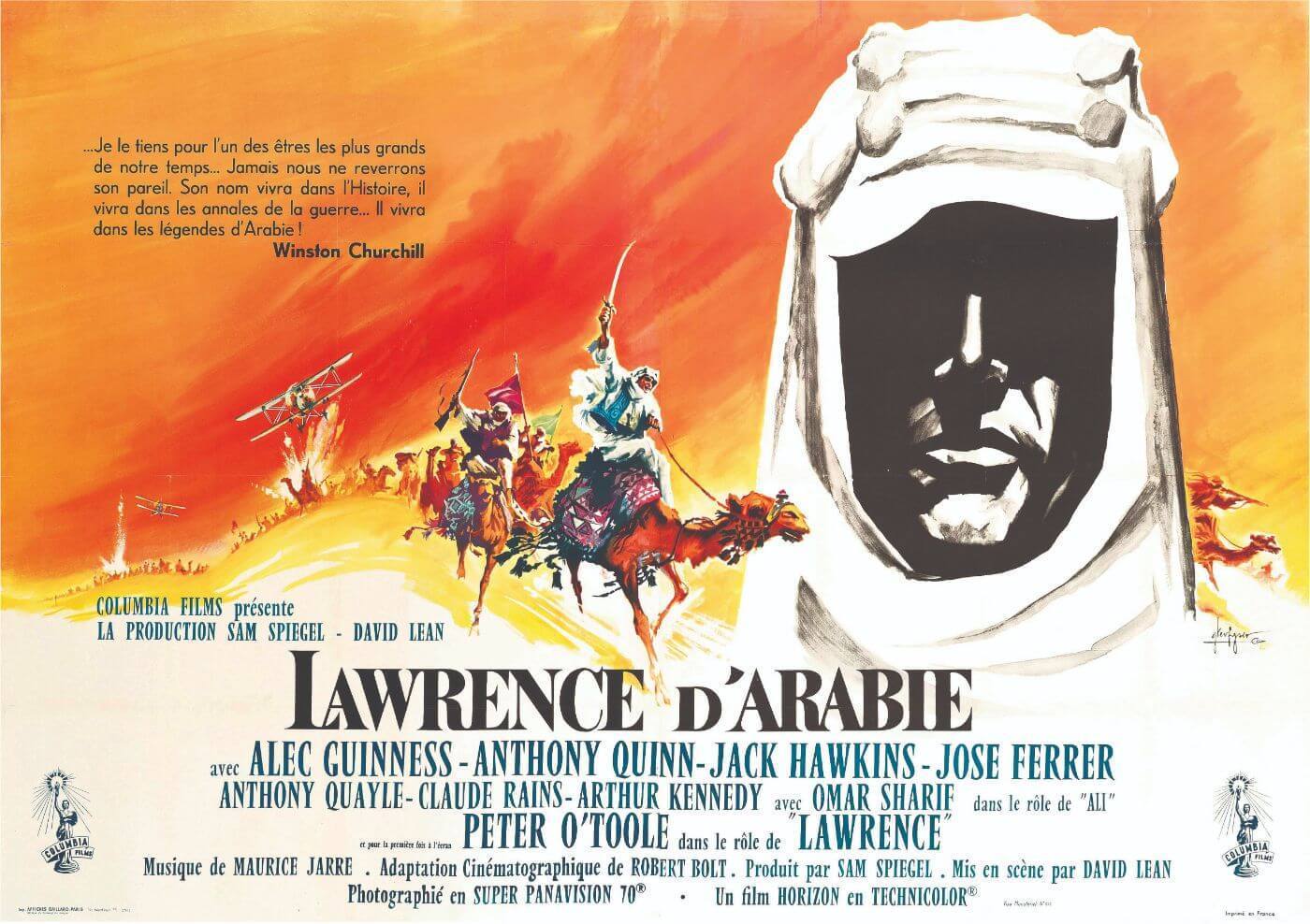
Film Facts
“I can’t make out whether you’re bloody bad-mannered or just half-witted” (General Murray). “I have the same problem sir (T.E Lawrence, Lawrence Of Arabia, 1963)
Lawrence Of Arabia is an Old Hollywood spectacular, a journey across the desert of Arabia as we follow Thomas Edward Lawrence, who fought alongside the Arab guerrilla forces, in his conquest to unite the Arabic kingdoms and empower the Arabic people during the destruction of World War I. T.E Lawrence is portrayed by Peter O’Toole, who turns out a strong performance in his interpretation of T.E Lawrence and his quirkiness and outrageous initiative and boldness. The film spans from the beginning of WWI, until his death in 1935, while interacting with a number of key characters such as Prince Faisal (Alec Guinness), Auda abu Tayi (Anthony Quinn, General Allenby (Jack Hawkins) and Sherif Ali ibn el Kharish (Omar Sharif). The supporting cast was all well recognised in their own right, combining to produce the legendary film that it is known to be.
The film follows the misfit T.E Lawrence as he is dispatched to assist Colonel Brighton in discussion with Prince Faisal on how to proceed in their fight against the Turks, and from here the sheer charisma of T.E Lawrence takes the spotlight, as he embarks on the journey to take Aqaba on a surprise attack, and everything to follow. ‘Lawrence Of Arabia’ is directed by the legendary David Lean, and the screenplay was written by both Robert Bolt and Michael Wilson. The film was based on the autobiography ‘Seven Pillars of Wisdom’ written by T.E Lawrence. The score was written by French composer Maurice Jarre, who teamed up with Lean for films to follow in ‘Doctor Zhivago’ and ‘A Passage To India’. The score is a resounding, traditional score that centres its focus on traditional instrumentation while exploring the various harmonic minor modality, providing an Arabic sounding score in its ‘Main Title’.
Track Facts
Composer
- Maurice Jarre
Label
- Colpix Records
Award Nominations
- Academy Awards – Best Music, Score – Substantially Original (Won)
- Golden Globes – Best Original Score (Nominated)
- Grammy Awards – Best Original Score from a Motion Picture or Television Show (Nominee)
- IFMCA – Best Archival Release of an Existing Score (Nominee)
- Laurel Awards – Top Song (Nominee)
Release
- 1962
The Jam
**This discussion is based on the basic soundtrack release on Spotify, not the extended edition nor any original soundtrack releases prior**
Boom Boom Boom Boom Boom! The timpani thrusts us into the world of T.E Lawrence and his spectacularly unique story in the deserts of what was then known as Arabia. Unique to films in Old Hollywood an Overture is played to a completely blank screen, as we sit, and listen to the famous hook from this film written in the Melodic Minor mode, an Arabic tone cemented into the score right from the beginning. Jarre moves the score along with the Timpani before introducing us to the core theme for this film, before then moving back to a number of percussive instruments and the number of various themes Jarre wrote for the film, acting as any overture would. What a thrill it is to sit and listen to the musical adventure written for the David Lean film, parallel to the adventure of T.E Lawrence, what a great way to build anticipation! The ‘Overture’ cements Jarre’s name in film music history as being only one of his significant achievements, and most importantly one of his very first.
Leading up to the film Jarre was ONE of THREE composers originally poised to score the film in a collaborative project, which included Russian composer Aram Khachaturian to compos the ‘Arabic styled’ theme music, and Benjamin Britten was asked to compose the ‘British style’ music, while Jarre was asked to compose the ‘Dramatic style’ music. Due to circumstances Britten and Khachaturian were unable to remain on the film, and after negotiations, editing and drafts, Lean was set on Jarre after hearing the various themes he had composed while in early pre-production.
For those who don’t have the ‘Director’s Cut’ or the ‘Special Edition,’ you would have missed the Overture above, and begun at the Main Theme, which essentially introduces the T.E Lawrence theme while the introductory credits roll. All the while an older T.E Lawrence takes off in his motorcycle as David Lean opts for the book-end opening scene, where we start at the end of Lawrence’s life, rather than the beginning. ‘Miracles’ is when the story begins to take place, as Lawrence makes his way across the desert with his companion. The eerie sounds of the strings, the deep percussion and the bassoon provide an appropriate backdrop to the desolate landscape. ‘Miracle’ builds atmosphere and sets a great backdrop for a montage, reacting to what’s occurring on-screen and Jarre executes these cues with tactfulness. The ‘Nefud Mirage’ works in a similar way, providing dizziness, and eeriness for Lawrence and Ali’s men as they make their way over the Nefud desert, one of the largest deserts in the area. The treatment of this sequence begins with a careful introduction with the strings, before setting a simple ostinato while they travel across the desert, embellishing instruments and notation when cue calls for it, relying heavily on the string family, specifically the harp as the track closes.
The ‘Rescue Of Gasim/Bringing Gasim Into Camp’ introduces a descending whole-tone scale and once again provides a certain eeriness and atmospheric quality, and Lawrence decides on going back for Gasim who had fallen off his horse from pure exhaustion and is now stranded in the Nefud. Once again we hear the Lawrence theme, always keeping us in the sweeping deserts of Arabia, and Jarre lifts the emotion in his brassy hits as Lawrence returns with Gasim against the odds, before finishing the track with the ‘Arabic Theme’ again, keep this melodic theme central to the score for the film. Following this is ‘Arrival At Auda’s Camp’ which again centralises around the T.E Lawrence theme while including a number of embellishments to support the visual stimulus.
Jarre brings a classic military feel to ‘The Voice Of The Guns’ beginning with a marching snare while introducing the brass instruments to provide melodic support and cymbals to accentuate the accented beats; The ‘British Military Theme’. The theme plays out at the British officers assemble for a meeting while inside the consulate, a fitting theme for the British Military. In ‘Continuation Of The Miracle’ Jarre designs a sparse harmonic range while Lawrence journeys across the desert, reusing similar elements from previous tracks in this soundtrack. Jarre keeps this track simple, slow and consistent, confident in his emotive energy without feeling the need to do too much.
‘Sun’s Anvil’ opens with dissonant harmonies and chordal tones, with a strong arpeggiated brass ostinato, driving the piece forward while providing tension for what is to come. Jarre provides a constant dissonance in this track which comes together at times with the ‘Arabic Theme’ before moving onward with the story. ‘Lawrence And The BodyGuard’ is what was first played in the Overture, featuring the percussive hits and harmonic minor scale work from the woodwind instruments, however, the track itself offers little development, moving through this ostinato a number of times while moving in and out of dynamic ranges, accompanying the performances on screen. Jarre begins ‘That Is The Desert’ similar to the way he began a number of tracks within this score in designing a sparse and atmospheric quality, allowing the various instruments of the orchestra to move in and out of this space. Jarre builds a great amount of tension, calling upon the entire orchestra to build the music up to meet the performances of the actors on screen. The ‘End Title’ begins the ‘Arabic Theme’ on what sounds like a harpsichord, before moving through various themes such as the ‘British Military’ theme and back to the ‘Arabic Theme’ before abruptly ending with a crescendo on the horns.
TFMJ’s pick from this score is the ‘Main Title’, beginning with steady string clusters, the percussion thunders in to drive the piece forward before moving through the various themes Jarre utilises throughout the film including the ‘Arabic Theme’, the ‘British Military’ theme while pulling certain dramatic elements from the score to link these core themes. It’s every bit epic and colossal as the film itself, demanding attention and stirring energy from the very start. This score sets the tone for this film and supports both the story and the setting, introducing us to the world of T.E Lawrence and the adventure to come.
Soundtrack Send-Off & Rating
‘Lawrence Of Arabia’ is an ‘Old Hollywood’ epic that reaches some of the highest heights in Hollywood accompanied by an equally prolific score. Jarre designs an aesthetic that is believable, emotional and adventurous while keeping the film consistent in its breakup between ‘British Military’, ‘Arabic Theme’ and ‘Dramatic Sequences’. Jarre designs a score that sweeps you off your feet as soon as the ‘Overture’ begins, and matches Lean’s vision in his characters and his setting. Jarre’s score is a reminder of his diversification and talent, and to this day remains one of the most celebrated scores, leading Jarre into one of the most prolific careers in film music and a strong partnership with David Lean.
To finish, I have included some words Jarre shared while reflecting on the process that Jarre went through in writing this score, “When you write the music for a film, do you know whether the film will be a great success? I tell them no, I was mainly concerned about finishing the music in time.. And that’s why the work was a little like Sam Spiegel said, ‘You have a job like Superman!’.. But at that point, I had no idea that I was working on probably one of the best films in the history of cinema” (Maurice Jarre, Interview with Alexandre Desplat, CNN, 2008/09)
References
 The Slow Spin: Soundtrack Sessions